
The context
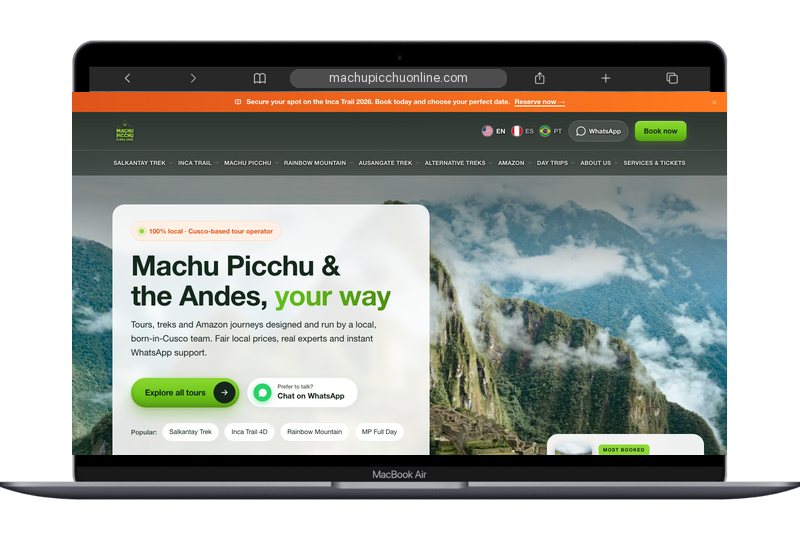
A local agency based in Cusco has to convince international travelers to trust it over a large booking platform, often before even talking to anyone. The site also had to speak to three different audiences — English, Spanish and Portuguese speakers — without Google treating them as a single duplicate piece of content.
The approach
The site highlights what an international platform can't offer: a local team, instant WhatsApp contact and real reviews (4.9/5 on Google & TripAdvisor). Coded in Astro rather than on a classic CMS, each language lives on its own URL (/en/, /es/, /pt/) with fully dedicated content.
SEO strategy applied
One indexable URL per language, not just a switcher
Each language has its own URL and its own content, rather than a JavaScript switcher that would hide the text — essential for Google to correctly index all three versions separately.
Hand-coded hreflang tags
Hreflang tags (en, es, pt, x-default) explicitly tell Google which version to show based on the searcher's language and country, preventing the versions from competing with each other.
A static site, built for mobile speed
Nearly all visitors arrive from a mobile search engine while planning their trip: a fully static Astro site guarantees near-instant loading, even on an average connection.
Content aligned with real search intent
Tour names reuse the exact terms travelers search for ("Salkantay Trek", "Inca Trail 4D", "Rainbow Mountain") rather than vaguer marketing language.
What makes the difference
- ✓Trilingual site (EN / ES / PT) with hreflang
- ✓Instant WhatsApp contact
- ✓Customer reviews (4.9/5) featured to build trust
By targeting each language with its own indexable content instead of a site translated on the fly, the site can appear in search results across three different markets, with load time that remains a trust argument in itself.
Other projects
🚀 Got a similar project in mind?
Tell me about your business, and let's see together what makes sense for you.